

100 signatures reached
To: Acting Vice-Chancellor Susan Elliot, Chancellor Claire Higgins, and all members of Deakin University Council
PLEASE do better, Deakin
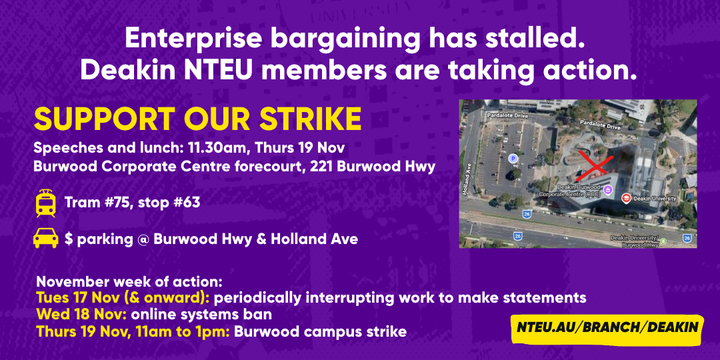
Deakin's leadership told us it had learnt its lesson after the cancellation of the proposed restructures of the Academic and Infrastructure and Digital portfolios. Addressing staff on Wednesday 8 July, the Chancellor and Caretaker Vice Chancellor committed to more consultative processes, a culture of valuing staff and students, and expressed their desire to improve relationships across the University.
Five months on, the language has changed, but the way we, and students, are treated has not. Decisions are still made solely at the top and justified by the need for "financial sustainability" with no substantiation of the claims this is under threat. Staff and students are still told what has been decided and that there is no alternative. No alternative to job cuts. No alternative to higher workloads. No alternative to inadequate support to students. No alternative to being valued in only words, not treatment."
The Deakin NTEU Branch is still asking for genuine communication, consultation and accountability from Deakin's University Council:
The Deakin NTEU Branch is still asking for genuine communication, consultation and accountability from Deakin's University Council:
- Show the balance. For each major decision – including the voluntary redundancy program scheduled for announcement on Thursday 19 November, the proposed Continuing Teaching Fellows mode of employment, and the considerable investment in software platform Workday – publish how it weighs financial risk against academic risk and the University's objects. Under s. 5 of the Deakin University Act 2009, our statutory objective is to be an excellent teaching and learning environment, undertake research of international standing, serve the public interest through the promotion of critical and free enquiry, and provide programs and services in a way that reflects principles of equity and social justice. Put that assessment to staff and students before the decision is made, not after.
- Open the books. Release the financial position, assumptions, reserves and options behind the "2029 crunch", including alternatives to job reductions, and work through them with staff and students before decisions are made, not after.
- Show the plan. Publish a workforce plan as part of the proposed voluntary redundancy scheme, showing how work will be covered and how remaining staff will not be overloaded or programs cut, and commit that the program will not be used to justify a wider restructure next year.
- Invest in teaching. Guarantee teaching can continue. Sustainability is not only financial: a university without enough academic staff cannot deliver its teaching programs. Show us the plan to maintain all academic programs, and ensure they are properly staffed with a balance of experienced and early career staff so they can lead and deliver courses. Withdraw the Continuing Teaching Fellows proposal and commit to secure, year-round employment and manageable workloads for teaching staff. Staff working conditions are student learning conditions: overloaded, insecurely employed staff cannot give students the time and support the University promises.
- Ensure bargaining in good faith and in the spirit of the aspiration to be Australia's most progressive university. Respond with counterproposals, before the end of 2026, to what Deakin members have made clear are our key enterprise bargaining claims – stability guarantee, genuine consultation, workload, pay, AI protections, equitable 17% super contributions for casuals, and improvements to redundancy/redeployment provisions. Establish firm commitments and clear dates for responses to the remainder of our claims.
Why is this important?
This is what the past five months have shown us about Deakin management's values and intentions:
- Bargaining without answers. After five months of enterprise bargaining, management has not given a substantive response to any of the union's claims.
- "Continuing" jobs that aren't. Deakin's proposed Continuing Teaching Fellow mode of employment is neither secure nor fair. This are the Higher Education sector version of zero-hours contracts, risking excessive hours in teaching periods and no pay outside of them. It will create a class of teaching staff with the worst conditions we have ever seen, affecting their wellbeing and the quality of teaching we deliver our students.
- These so-called continuing jobs offer no job security and amount to no work and no pay outside of teaching periods in which work is required. Teaching is not seasonal work.
- Redundancies first, plan later. A voluntary redundancy program has been launched before the redundancy claims are answered, and with no workforce plan for who will teach, supervise and support students once colleagues leave.
- Money for systems, but not for people. The same email that announced the voluntary redundancy program also announced approval of the first stage of the multi-year 'Digital Core' program, which can reasonably be assumed to require a multimillion dollar investment. Upgrades are not the problem. The problem is that staff are always the first place savings are sought, while a hiring slowdown overloads those who remain.
"Financial sustainability" is an empty slogan
When staff ask for manageable workloads, adequate teaching resources or proper support, the response is "financial sustainability", and the conversation ends. But a university is financially sustainable so that it can teach, research and serve the public. If sustainability is the reason it cannot do those things, what is it sustaining? Executive salaries? Legal fees to challenge Freedom of Information requests about remuneration? Consultancy fees? A $720 million Future Fund that will never be used?
We are not opposed to sustainability, nor to upgrades. We are opposed to treating job losses as inevitable, and any particular technological future as inevitable, when both are choices that should be debated openly. The "2029 crunch" has been asserted but not shown: no figures, no underlying assumptions, no account of reserves or options have been presented to staff. A crisis that cannot be examined cannot justify cuts, freezes and insecure work.
Governance is how staff and students experience the university
Governance is not only policy. It is whether people experience decisions as something done to them or something they can take part in. Two models are in conflict. In the corporate model, leaders decide, announce, and "consult" on what has already been settled. In the academic model, those who do the work help shape decisions about it. June showed the first. The Vice-Chancellor left and the pattern stayed.
Governance is not only policy. It is whether people experience decisions as something done to them or something they can take part in. Two models are in conflict. In the corporate model, leaders decide, announce, and "consult" on what has already been settled. In the academic model, those who do the work help shape decisions about it. June showed the first. The Vice-Chancellor left and the pattern stayed.
The Chancellor has acknowledged that increasing staff and student representation in university governance structures has its limits. We agree. A positive governance culture means that staff and students must have meaningful opportunities to participate in decisions about the University, not be informed of decisions afterwards. This includes fully understanding our financial position and being able to offer ideas about how to achieve a sustainable future for it.
The Deakin University Act 2009 puts the responsibility for University Governance with Council, but affirms that staff and students are part of the University (s 4(3)). The institution's first object is to provide and maintain an excellent teaching and learning environment (s 5(a)). Council must approve the mission and the budget together (s 8(3)(b)), oversee risk across the University (s 8(3)(f)) and oversee its academic activities (s 8(3)(g)), and its members must act for proper purposes consistent with the University's objects (s 15(2)). Council should be able to show how financial decisions are weighed against all of this.