-
 End the Pay Gap for Social Workers and Occupational Therapists in the Public Mental Health SystemEvery day, social workers and occupational therapists stand alongside nurses in Victoria's public health system. We work in the same hospitals. We care for the same patients. We respond to the same crises. We help people recover, stay safe, and rebuild their lives. Yet we're still paid less. The Fair Work Commission has recognised that allied health professions have been historically undervalued because they are female-dominated professions. Now it's time for Victoria to act. Equal pay isn't about asking for more than we deserve. It's about recognising the value of the work we already do and if things don't change and the Victorian Labor government doesnt provide pay parity with our mental health nursing colleagues, 97% of social workers and occupational therapists will leave the public mental health system. Social workers support people through mental health crises, family violence, child protection concerns, homelessness, trauma, palliative care, and complex discharge planning. Occupational therapists help people regain independence after injury or illness, prevent hospital readmissions, support rehabilitation, identify support within the NDIS and enable people to live safely at home. These aren't "extra" services, they're essential healthcare. When experienced allied health professionals leave because they can earn more elsewhere, patients wait longer, services suffer, and communities miss out. We need the Victorian Government to deliver: • Pay parity with our nursing colleagues where we perform equivalent work and responsibilities. • Fair recognition of the skills, qualifications, and value social workers and occupational therapists bring to public healthcare. • A workforce that can attract and retain experienced clinicians. This isn't just about workers. It's about protecting the future of Victoria's public mental health system for consumers, carers and their families. If you believe every essential mental health professional deserves equal recognition for equal value in the public mental health system, add your name. It's time for pay equity for social workers and occupational therapists.2,203 of 3,000 SignaturesCreated by Health and Community Services Union (HACSU)
-
 Save our group homes!Residential group homes are an essential public service for individuals living with disabilities. Homes provide a safe environment, supported by public sector workers who have dedicated their careers to caring for individuals with high support needs. Privatising these services will force families to make agonising choices, separate clients from carers and leave 400+ public sector workers without jobs.1,923 of 2,000 SignaturesCreated by CPSU CSA

-
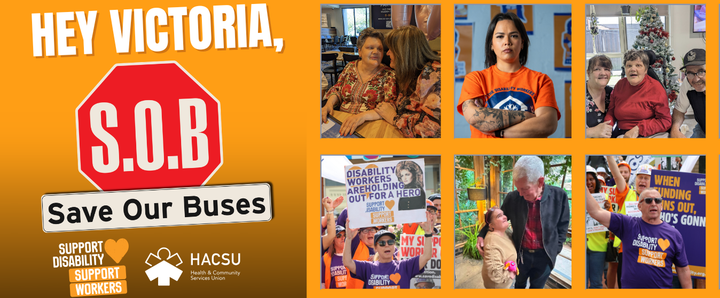 Save Our Buses - Stop the Scope and Possability Transport Sell-Off!!This issue matters because transport is not optional for people living in supported disability accommodation- it is a fundamental support that determines whether people remain connected to their communities or become isolated within their own homes. For many residents, these buses are the only safe, reliable, and accessible way to attend medical appointments, participate in community activities, visit loved ones, shop for essentials, and maintain the independence, dignity, and routine that most people take for granted. The sale of these buses risks dramatically reducing residents’ access to healthcare, social participation, and community connection, increasing loneliness, dependence, and exclusion. Without reliable transport, people may miss appointments, withdraw from activities, lose confidence, and experience a serious decline in quality of life. For some, this decision could effectively leave them trapped at home, prisoners in their own accommodation with little meaningful access to the outside world. What makes this decision even more concerning is that these buses were originally provided to Scope and Possability at no cost by the Victorian State Government to support inclusion and community access for people with disability. Selling off assets intended to improve the lives of supported independent living residents, while withdrawing a critical service many depend on, sends a troubling message about priorities particularly on the backdrop of the Victorian Disability Sector Crisis. Share this petition to demand that Scope and Possability halt the sell off and the Victorian State government intervene!1,870 of 2,000 SignaturesCreated by Health and Community Services Union
-
 Sign the petition: Increase the fuel allowance NOW!We the undersigned, are writing to raise serious concerns about the combined impact of rising petrol prices, and inadequate award travel allowances payable to disability support workers. As you are no doubt aware, disability support workers are an essential workforce. Their work is inherently mobile. Workers are required to travel between multiple participants each day, often across significant distances, at all hours, and in locations where public transport is not a viable option. As a result, the vast majority rely on their own vehicles to deliver NDIS-funded supports. Sustained increases in petrol prices following the conflict in Iran have substantially increased the out-of-pocket costs borne by our members. However, neither the award travel allowance nor NDIS pricing arrangements adequately reflect this reality. The current award travel allowance only $0.99 per kilometre does account for sustained increases in petrol prices. As fuel costs rise, the real value of these allowances erodes further, effectively resulting in a reduction in workers’ take-home pay. At the same time, NDIS pricing settings do not provide a mechanism that meaningfully responds to sharp increases in fuel costs. While pricing models recognise labour and some operational costs, they do not adequately account for real-world travel expenses borne by workers. This situation is unsustainable. It is contributing to financial stress for workers, and ultimately undermines service continuity and choice for people with disability when workers are forced to consider working elsewhere due to increased out of pocket transport costs. In the immediate term, we urge the NDIA to work with Government, providers and unions to introduce an interim travel loading payable to disability support workers within NDIS pricing to respond to fuel price volatility. An interim loading would provide immediate relief while longer-term pricing and industrial issues can be addressed. Such a loading would be linked to recognised fuel price indicators to ensure it reflects real-world costs applied on a temporary basis while petrol prices remain elevated. Such an approach would be consistent with the way in which the sector sought to address financial implications on workers in the sector during the Covid-19 pandemic. Disability support workers perform skilled, complex and demanding work that is central to the success of the NDIS. They should not be expected to absorb escalating fuel costs simply to keep the Scheme functioning606 of 800 SignaturesCreated by Australian Services Union

-
 Hands off Clare House!This is not just about a building. It is about protecting the dignity, comfort, and wellbeing of some of our most vulnerable community members. Please sign this petition to tell the government that mental health services deserve better, and that consumers, their families, staff and the community deserve a say.639 of 800 SignaturesCreated by Health and Community Services Union TAS (HACSU)

-
Rural Young People deserve mental-health crisis careYoung people in the Hume and Riverina regions currently have no access to local, age-appropriate acute inpatient mental health care. When adolescents experience severe mental health crises, they are too often admitted to adult wards, left for extended periods in emergency departments, or transported hours away from their community by family or patient transport, even when there is an immediate danger to themselves. These arrangements are clinically inappropriate, distressing, and inconsistent with trauma-informed standards of care. They disrupt schooling, separate families, and increase the risk of further harm - emotionally, socially and physically. Albury–Wodonga is centrally positioned to reduce unsafe travel distances across both Victoria and New South Wales, while easing pressure on already stretched metropolitan services. This is about safety, equity, and ensuring crisis care is available close to home when it is needed most.549 of 600 SignaturesCreated by katie kendall
-
 LGH: Pay rises before parking pricesHealthcare workers at the Launceston General Hospital are being hit with an almost 70% increase in parking fees. This isn’t a small adjustment – an extra $520 a year is a massive cost increase on people who already struggle to find affordable, reliable parking just to get to work. What makes this even worse is the timing. During bargaining, workers have missed out on wage increases because the government has refused to put a fair offer on the table. In the last 12 months, healthcare workers have faced growing wage disparity with the mainland, seeing the gap for their wages widen from 5.92% to 9.8%. For many healthcare workers, parking isn’t optional. If you’re on early shifts, late finishes, or rotating rosters, public transport often isn’t a realistic alternative. That means this decision becomes a direct cost-of-living hit for the very people who keep our hospital running. Healthcare workers deserve respect and fairness, not another financial burden. The government must act to commit to treating workers properly by covering the fee increase and maintaining the arrangement with workers of parking costing $3 per day.371 of 400 SignaturesCreated by Health and Community Services Union TAS (HACSU)
-
 Medicare for Seasonal WorkersPeople from the Pacific Islands and Timor Leste that come to work in Australia on the Pacific Australia Labour Mobility (PALM) Scheme do not have access to Medicare. Instead they are required to pay for private health insurance arranged through their employer. Too often the complexity of using private health insurance or lack of support from their employer results in workers not getting the vital medical care they need.600 of 800 SignaturesCreated by Mark Zirnsak
-
 Save Rosary Gardens Aged Care Facility - Help us reach 1,000 signatures.The proposed closure of Rosary Gardens, a facility with 94 Beds represents a critical loss of essential residential aged care capacity in the Hobart area, particularly New Town. We recognise the broader trend towards home-based care, but this closure fails to account for the ongoing and growing need for high-level, complex, and dementia-specific residential care that a facility like Rosary Gardens provides. The closure will cause immediate and severe adverse effects to: Vulnerable Residents: Forcing the relocation of elderly, frail residents, many with complex needs like dementia, which is a traumatic and dangerous process proven to lead to accelerated health decline, confusion, and loneliness. Families and Support Networks: Relocation to distant facilities severs established community ties, makes regular visits difficult, and diminishes the critical role of family support in a resident's well-being. Local Aged Care Capacity: The loss of Rosary Gardens exacerbates the existing shortage of aged care beds in Tasmania, making it harder for other residents in the community to access the care they need. A Dedicated Workforce: The closure, despite reports of staff not facing redundancy, causes distress and uncertainty for the dedicated local nurses, care workers, and support staff, destabilising the health sector workforce. The Action Requested We call on the Tasmanian Government to take the following actions: 1. Initiate Emergency Negotiations: Immediately engage with Southern Cross Care (Tasmania) Inc. to explore all possible options for the facility to remain open, including urgent financial assistance, revised funding models, or a temporary operating subsidy to ensure the service's sustainability. 2. Secure Future Residential Care: If the current provider is unwilling to continue operations, the Government must actively facilitate the transfer of the facility's operation to another suitable, financially stable, and accredited aged care provider to ensure the beds and the existing infrastructure remain available for the community or take this facility over and run it as a public owned and operated facility. 3. Conduct a Local Needs Assessment: Commission an urgent, transparent assessment of the immediate and future residential aged care needs in the New Town and greater Hobart area to justify the absolute necessity of maintaining Rosary Gardens' services. We urge the Government to prioritise the well-being and stability of our most vulnerable citizens over a strategic business decision.1,115 of 2,000 SignaturesCreated by ANMF Tasmania

-
 Co-Fund the Royal Hobart Hospital (RHH) Clinical Trials UnitThe Clinical Trials Unit plays a critical role in advancing medical research, improving patient outcomes, and providing Tasmanians with access to cutting-edge treatments that may otherwise be unavailable. It supports innovation, attracts skilled professionals, and contributes to the broader health system through evidence-based care. Despite its importance, the Unit is currently under pressure due to workload challenges, staffing shortages, and uncertainty around future funding. Without adequate support, the Unit risks being unable to meet demand, compromising both patient care and research capacity. The Time to Act is Now Investing in clinical trials is an investment in the future of healthcare. It ensures Tasmanians benefit from the latest medical advancements and that our health system remains at the forefront of research and treatment. We stand in solidarity with the staff and patients who rely on this vital service.202 of 300 SignaturesCreated by ANMF Tasmania
-
 Keep The Hobart Clinic OpenThe Health Minister has suggested that patients can go elsewhere in the public system but we know this simply isn’t true. The Hobart Clinic is the only service in the state offering vital treatments such as inpatient TMS. Without it, patients would need to be much sicker before they could be admitted through the emergency department. Wait times will grow even further, already stretched public services will be pushed beyond breaking point, and lives will be placed in real danger. The Hobart Clinic plays a crucial role in keeping people well and out of the public system. Most patients are lower acuity and would never qualify for crisis-based hospital services. What are they meant to do when there is nothing else like this available anywhere in Tasmania? Some will have to consider travelling interstate to access the same kind of treatment – an option most simply cannot afford. Staff have been treated terribly throughout this entire process. They found out about the closure only an hour before the news was released to the public. These are dedicated professionals who pour their hearts into delivering some of the best mental health care in the country but they've been treated with nothing but contempt. The Hobart Clinic, as a registered charity, exists to serve the community, not to generate a profit. Not that long ago, the Hobart Clinic was even discussing expansion – so how has it come to this? Why should patients and staff bear the burden of years of financial mismanagement?3,362 of 4,000 SignaturesCreated by HACSU Tasmania
-
 NT Health PharmacyThe NT Government’s failure to act means dangerously understaffed pharmacy departments are left to cope under impossible conditions. Pharmacists and technicians are exhausted, patients face delays and reduced services, and communities risk losing access to essential healthcare. Every message, every call, and every signature sends a strong signal: pharmacists across Australia will not accept unsafe staffing and government neglect. Together, we can protect patients and support our profession. In solidarity, Professionals Australia2 of 100 SignaturesCreated by Professionals Australia